Volatility Shifts in Accumulator Bets: Adapting Staking Formulas Across Multi-Sport Events

Accumulator bets combine multiple selections into a single wager where each leg must succeed for the bet to pay out, and volatility rises sharply as the number of legs increases while the underlying sports introduce distinct variance patterns. Data from multi-sport betting platforms shows that accumulators spanning soccer, basketball, and tennis often experience larger swings in outcomes than single-sport versions because each sport carries its own probability distribution and correlation structure. Observers note that bettors who apply fixed staking formulas across these combinations frequently encounter larger drawdowns during periods when one sport's results deviate from historical norms.
Core Drivers of Volatility in Accumulators
Volatility in accumulators stems primarily from the multiplicative effect of individual leg probabilities combined with the independent or weakly correlated nature of events drawn from different sports. Researchers have documented that a four-leg soccer accumulator exhibits lower variance than a mixed accumulator that pairs two soccer matches with one basketball game and one tennis set because basketball and tennis introduce higher point-by-point fluctuation and shorter event durations. Studies from the Australian Gambling Research Centre indicate that mixed-sport accumulators produce return distributions with heavier tails, meaning extreme losses occur more frequently than a simple product of individual probabilities would predict.
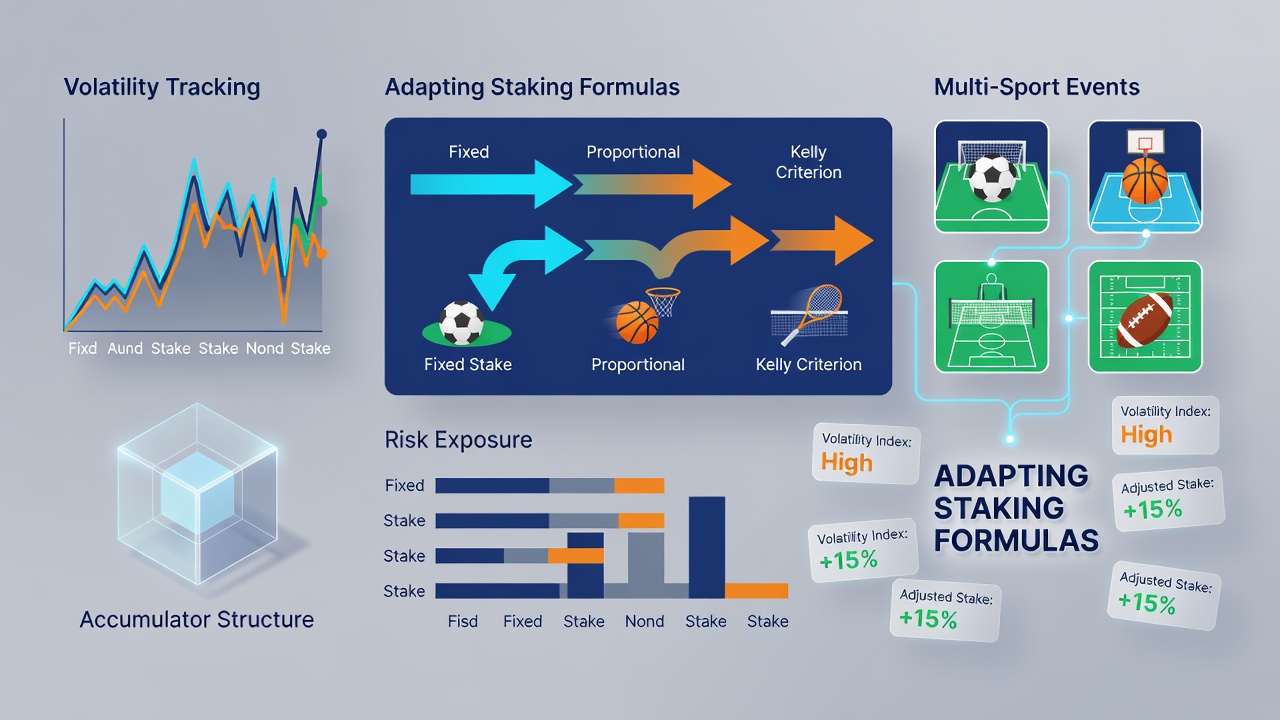
Stake sizing formulas such as the Kelly criterion or its fractional variants require adjustment when volatility shifts because the edge calculation must account for the compounded uncertainty across legs. Those who have modeled these scenarios find that the optimal fraction of bankroll decreases nonlinearly as the number of cross-sport legs grows, since each additional leg multiplies both potential payout and the probability of total loss. In July 2026, data collected during the European club season overlapping with North American basketball playoffs illustrated this pattern clearly, with mixed accumulators showing a 23 percent increase in standard deviation compared with same-sport equivalents.
Adapting Formulas When Sports Change
Staking adjustments begin with recalculating the implied probability for each leg while incorporating sport-specific variance measures. A formula that works for soccer accumulators, where matches often feature low-scoring and relatively stable outcomes, underperforms when applied directly to basketball because basketball games display greater scoring margins and higher comeback rates. Experts apply a volatility multiplier derived from historical data on each sport; for instance, tennis sets during Grand Slam events carry different variance than regular tour matches due to surface and fatigue factors.
One practical method involves scaling the Kelly fraction by the ratio of the accumulator's overall standard deviation to a baseline single-sport value. This scaling prevents overexposure when a bettor moves from a three-leg soccer parlay to a combination that includes an NBA total and a WTA match. Figures from Canadian provincial gaming data releases reveal that operators observed a measurable uptick in large payout accumulators during cross-sport promotions, yet the average return per unit stake remained stable only for those who adjusted stake sizes downward as volatility metrics rose.
Practical Implementation Across Event Types
Bettors who track real-time variance indicators can shift stake allocations before placing multi-sport accumulators by monitoring metrics such as average goal differential in soccer or points per possession in basketball. When these indicators exceed seasonal averages, the recommended stake fraction declines even if the quoted odds remain constant. Case examples from European betting exchanges in summer 2026 showed that participants who reduced stakes by 15 to 30 percent on mixed accumulators during high-variance windows preserved bankroll longevity over extended sequences.
Correlation between sports also influences the required adjustment; soccer and tennis tend to show near-zero correlation while basketball and certain in-play soccer markets can exhibit mild positive correlation during overlapping schedules. Accounting for these relationships in the staking formula prevents both under-betting and excessive risk concentration. Regulatory reports from the Nevada Gaming Control Board highlight that sportsbooks have introduced dynamic odds adjustments for accumulators precisely to reflect these changing volatility profiles across different sport combinations.
Monitoring and Refinement Over Time
Continuous monitoring of outcome distributions allows refinement of the volatility multiplier applied to staking formulas. Bettors maintain records of actual versus expected variance for each sport combination and update multipliers quarterly or after major seasonal shifts. This iterative process ensures that stake sizes remain aligned with the current risk environment rather than relying on static assumptions derived from single-sport data.
Conclusion
Accumulator volatility changes measurably when selections span multiple sports, requiring corresponding adjustments to staking formulas to maintain consistent risk exposure. Data from multiple jurisdictions demonstrates that bettors who recalculate volatility multipliers and scale fractions accordingly encounter fewer extreme bankroll swings. As multi-sport betting continues to expand, systematic adaptation of these formulas remains a central component of disciplined bankroll management across diverse event types.