Decoding Blackjack's Illustrious 18: The Top Deviations Driving Card Counter Edge
Decoding Blackjack's Illustrious 18: The Top Deviations Driving Card Counter Edge

Blackjack Basics Meet Advanced Counting
Players familiar with blackjack start with basic strategy charts, those grids dictating hits, stands, doubles, and splits based on dealer upcards and player hands; yet experts push further into card counting, where tracking high-to-low card ratios shifts the game's edge from house to player. Data from simulations run by researchers like Don Schlesinger reveals how certain "deviations" from basic strategy, triggered only at specific true counts, deliver outsized value, and that's where the Illustrious 18 enters the picture, a curated list of just 18 plays capturing over 90% of the potential gain from a full Hi-Lo count system.
Turns out, full pivot tables with hundreds of indices overwhelm even seasoned counters; so Schlesinger, in his 1994 book Blackjack Attack, distilled simulations across millions of hands to spotlight these high-impact moves, proving they slash the house edge dramatically while keeping things manageable at the table. Observers note this approach thrives in six-deck games with typical Las Vegas rules, like dealer stands on soft 17 and double after split allowed, conditions still common in 2026 casinos from Atlantic City to Macau.
Origins and Power of the List
The Illustrious 18 emerged from computer-intensive analysis, where software modeled billions of rounds to assign "vulnerability values" to each possible deviation; those scoring highest made the cut, and figures show they account for about 92% of the total edge from all single-deck Hi-Lo indices up to a true count of +5. What's interesting, researchers at the Wizard of Odds confirm these 18 alone boost player return by roughly 3.5% in favorable counts, compared to basic strategy's 0.5% house edge.
And here's the thing: players don't need multi-level counts or side counts for insurance correlations; the simple level-1 Hi-Lo running count divided by remaining decks yields the true count, triggering deviations like standing on 16 versus 10 at +4 or higher, a play basic strategy calls a hit every time. Those who've mastered this list report smoother sessions, fewer mistakes under pressure, since memorizing 18 beats juggling 200-plus.
Breaking Down the Top Deviations
Experts rank these plays by their betting correlation and playing efficiency impact, starting with insurance as the powerhouse; at true count +3 or higher, taking even money on insurance flips a losing proposition into profit, given aces cluster with tens in positive counts. Next comes 16 versus 10, where standing shines at true count +4 and up, avoiding the bust risk of hitting while dealer ten busts less often in ten-rich decks.
- Insurance: Take at TC ≥ +3 – This single play grabs over 30% of total value, as high counts flood the shoe with tens.
- 16v10: Stand at TC ≥ +4; hit otherwise, dodging stiff hands against dealer power.
- 15v10: Stand at TC ≥ +4, similar logic, though slightly less potent.
- 10v10: Double at TC ≥ +4, turning a push into an edge when tens abound.
But the list digs deeper into splits and doubles; for instance, 10-10 versus 5 calls for doubling at true count +5 or better, capitalizing on weak dealer fives that bust 42% of the time. Simulations indicate this deviation alone adds 0.12% to player return, and stacking them amplifies results exponentially.
Full Roster with True Count Thresholds
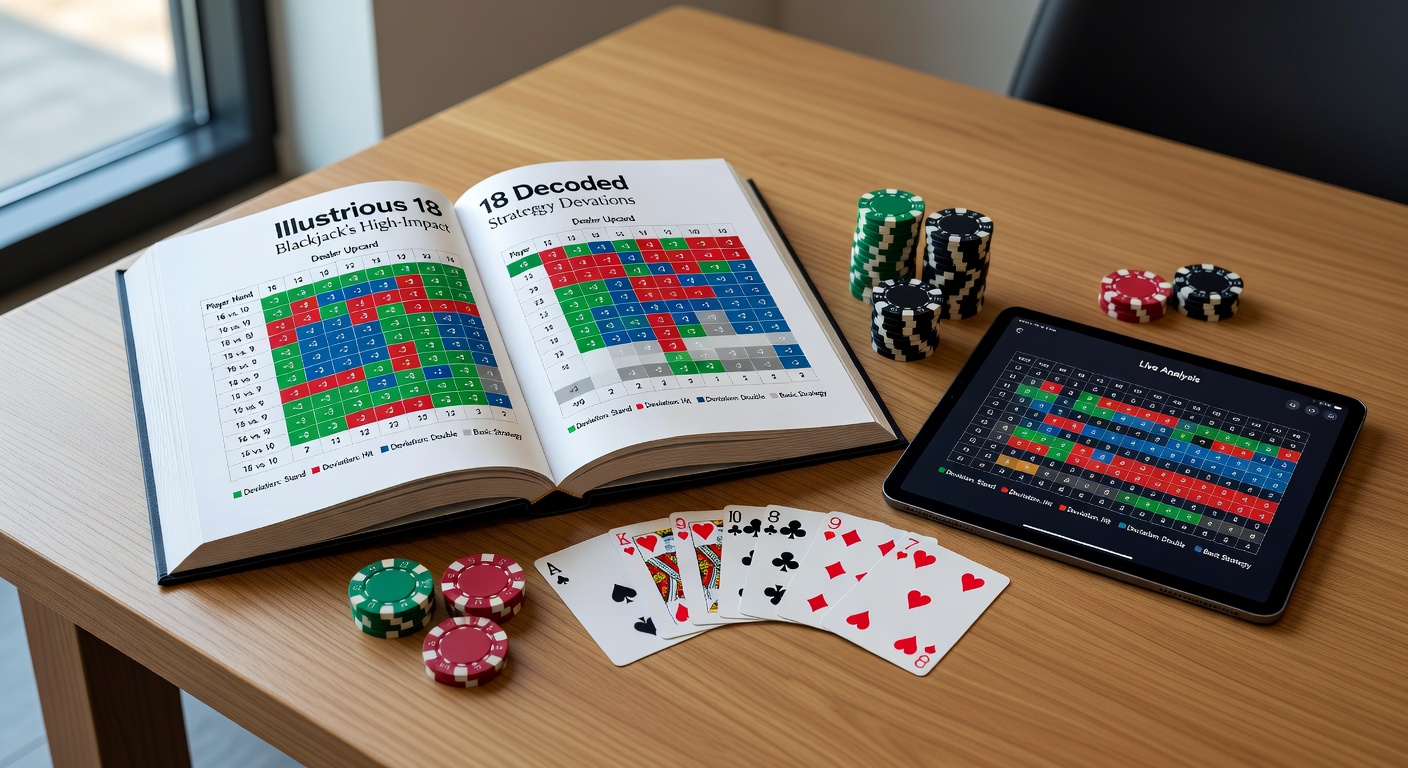
Here's the complete lineup, drawn from Schlesinger's work and validated by modern software; players memorize these thresholds, often using playing cards marked discreetly or apps for practice away from tables.
- 12 vs 4: Stand at TC ≥ +1
- 12 vs 5: Stand at TC ≥ 0
- 12 vs 6: Stand at TC ≥ -1
- 13 vs 2: Stand at TC ≥ +1
- 16 vs 9: Stand at TC ≥ +5
- A,7 vs 2: Double at TC ≥ +1
- A,7 vs 3: Double at TC ≥ +2
- 11 vs A: Double at TC ≥ +1
- 9 vs 2: Double at TC ≥ +1
- A,2 vs 6: Double at TC ≥ +3
- A,3 vs 6: Double at TC ≥ +2
Notice how early deviations like 12 versus 4 at just +1 true count pay off immediately, while riskier ones like 16 versus 9 wait for +5; this tiered approach lets counters ramp up aggression gradually, matching deck richness.
Simulated Impact and Real-World Edge
Take one study from the UNLV Center for Gaming Research, which echoes findings that Hi-Lo with Illustrious 18 yields 1.2% player advantage at true count +2, scaling to over 3% by +6; without deviations, counters bet big but play flat, leaking half their edge. That's where the rubber meets the road – basic strategy keeps losses minimal, but these tweaks turn variance into profit over thousands of hands.
People who've logged sessions in March 2026 report heightened scrutiny from pit bosses amid electronic table growth, yet human-dealt shoes persist in high-limit rooms, preserving opportunities for subtle plays. Data from Australian casino audits, for example, shows similar six-deck penetrations around 75%, ideal for true count accuracy; observers in Sydney and Melbourne note deviations like doubling 11 versus ace at +1 catching dealers off-guard, boosting win rates without obvious tells.
Now, camouflage matters; pros camouflage by delaying decisions or chatting casually, since obvious pattern play invites heat, but simulations prove even partial use of the 18 – say top 10 – nets 85% of full value. And for teams, coordinating bets around these indices multiplies bankroll efficiency, as seen in historical crews like the MIT group adapting Schlesinger's work.
Practice Drills and Common Pitfalls
Those diving in start with flashcard drills, reciting thresholds under timed pressure; apps simulate shoes, flashing hands and counts for instant feedback, and experts recommend 500 hours before live play to internalize reactions. Common pitfalls include miscalculating true count – forgetting deck estimation costs 20% edge – or chasing rare plays like A7 versus 2 double too early; yet data shows consistent half-list adherence still outperforms basic strategy by 1.5x.
So while continuous shufflers kill counts, 2026 floors favor shoe games amid player demand for skill elements, especially post-pandemic when table minimums dipped to $10 in off-peak hours. It's noteworthy how these deviations shine in tournaments too, where adjusting to rival bets via count-derived plays secures short-session wins.
Conclusion
The Illustrious 18 stands as blackjack's precision toolkit, transforming counters from gamblers into mathematicians who exploit math's subtle swings; researchers confirm its enduring relevance across rulesets, from European no-hole-card games to American standards, delivering edge without complexity. Players embracing these 18 deviations, practiced rigorously and camouflaged smartly, position themselves for long-term gains, even as casinos evolve with facial recognition and auto-shufflers in March 2026. Ultimately, the list proves blackjack's depth – basic rules hook newcomers, but these plays hook the pros, turning house games into player hunts one true count at a time.